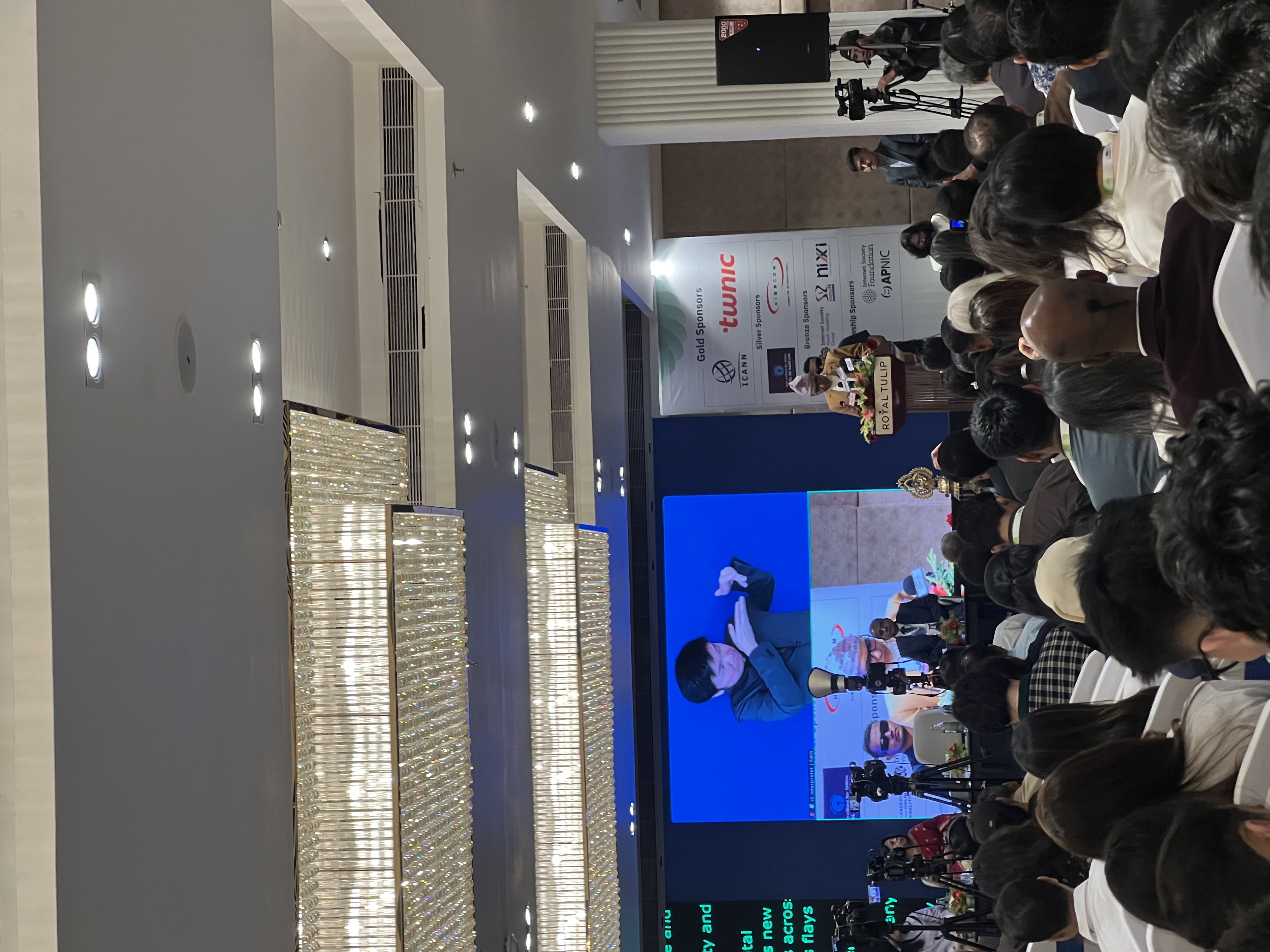
I’ve never had to travel far for a conference that felt this far from my usual world. APrIGF 2026 was in Kathmandu, where I live, but the room felt like somewhere else entirely, sixteen countries, people who’d flown in from across the region, all there to govern the internet I’d always just built things on.
APrIGF 2026 was the 17th Asia Pacific Regional Internet Governance Forum, held in Kathmandu this October under the theme Safeguarding a Resilient Internet in Times of Crisis. I was one of 38 fellows selected from across the region, one of very few from the host country. Being local surfaced something I hadn’t expected: how much gets decided about Nepal’s internet in policy rooms and governance structures without engineers from here in those conversations.
The AI Conversations I Wasn’t Expecting
I’m a CTO. I build systems, lead engineering teams, and plenty of what I’ve shipped uses machine learning in the background. In the industry I’d gotten used to talking about AI in terms of models, APIs, and performance numbers, not accountability.
The first session I attended, Seeing the Bias: AI Bias, Misinformation, and Inclusive Digital Futures, changed that quickly. The speakers went through real, documented cases of AI-generated misinformation spreading across South and Southeast Asian platforms: wrong health information, politically loaded content, moderation decisions affecting millions. The question that kept coming up was whose data actually trains these models, and whose reality gets lost when that data isn’t representative.
Governing AI Training Data in the Asia-Pacific the next day went into why that matters technically. Large foundation models are trained on datasets where Asian-language content is massively underrepresented, so when those models get deployed in our markets, they’re working off assumptions that don’t apply here. South Korea and Japan are starting to build regulatory responses to this. Nepal wasn’t part of those conversations when the rules were being written.
Day 3 had the one that really stuck: The Right to Be Forgotten by AI, presented by Nepali researchers. The question they raised was one I honestly hadn’t thought about before. Once someone’s knowledge, stories, or cultural material ends up inside a foundation model, can it ever actually be removed? What does that mean for communities where oral history and indigenous knowledge are now embedded in systems they didn’t consent to, can’t audit, and have no real recourse against?
I left thinking about the decisions engineers make without framing them as governance decisions: what gets stored, what gets used for training, what gets kept. A lot of those calls should involve a much wider set of voices.
Nepal’s Internet, When You Actually Measure It
Nepal recorded 132 disaster events in 2024. Floods, landslides, earthquakes. I’ve grown up with this as background noise, just part of how things are. APrIGF gave me a way to see those disruptions through a technical and policy lens I didn’t have before.
Let’s Measure the Internet: RIPE Atlas for APAC Digital Resilience used Nepal as a case study, specifically around the government’s social media ban. Distributed measurement probes across the country captured exactly when the ban hit: the drop in traffic, the VPN spike that followed, the differences in how it played out across regions. The data existed. What didn’t exist was a public system to surface it to the people who needed it, civil society, technical teams, journalists, while it was happening. Engineers were working blind during an active disruption. A governance failure, not a technical one.
When Submarine Cables Go Dark made the infrastructure dependencies concrete. Nepal is landlocked and doesn’t own undersea cables, but nearly all of our international bandwidth depends on infrastructure we have zero oversight of. The session used the Matsu 2023 incident to walk through what a cable cut actually looks like: traffic rerouting, latency spikes, a governance vacuum about who’s responsible. Countries like ours don’t have a seat at that table.
The one that tied it together was When an Energy Crisis Becomes a Connectivity Crisis. Disaster resilience plans that treat power and internet as separate systems are planning for a version of reality that doesn’t exist. In Nepal this happens regularly: a substation floods, towers go down, and the people who most need to communicate are the ones who can’t. The layered redundancy framework discussed there, across energy, connectivity, and communication channels together, was the most practically useful technical thinking I came across all week.
The Fellowship Itself: Two Languages, Four Days
Fellows don’t just get a conference pass. Before the event, we complete ISOC internet governance courses and do coordination calls with a mentor from the Multi-Stakeholder Steering Group. At the event, you attend sessions across different tracks, help with the Drafting Committee for the APrIGF Synthesis Document, and prepare a group presentation for Day 3.
Day 0 was a Capacity Building session, an afternoon for fellows, youth IGF participants, and newcomers to get oriented. What I didn’t expect was how useful that room would be. Engineers, lawyers, researchers, community organizers, all trying to talk about the same problems in very different ways. Having to explain technical concepts to a policy audience and actually be understood is a different skill. I got better at it across the week.
Our group, Buddy Group 8, presented on Communication and Connectivity Before, During and After Disasters. Not a hard topic to pick. It was exactly what I’d been thinking about all week.
We pulled together what we were hearing across the four days: the RIPE Atlas measurement work, the energy-connectivity research, the South Asia rapid-response protocol discussions, community network approaches from Myanmar and the Philippines. What kept coming through was that disaster communication in Nepal doesn’t fall apart because the technology isn’t there. Early warning systems exist, backup power exists, local-language messaging exists. What’s missing is coordination: a clear governance structure that says who activates what, under whose authority, and who answers for it when the chain breaks.
On Day 3 we presented to the full room. The core argument was simple: stop treating community communication systems as a backup plan and build them as the primary one. The questions that came back were harder than I expected, and more useful for it. Presenting to a room of policymakers and researchers is a different thing from presenting to engineers.
What Comes Back With Me
Internet governance used to feel like something that happened far away and handed down consequences, policy documents that eventually became rules constraining what you could build. Being at APrIGF made it feel live. The problems were immediate, the people were serious, and the gap between what engineers do and what governance frameworks decide felt narrower than I’d assumed.
The APrIGF 2026 Synthesis Document, which fellows helped draft, will go to IGF 2026 in Nairobi in December. It carries recommendations from sessions I attended, discussions I was part of, and a presentation my group gave in Kathmandu. A recommendation that started in a room in Gwarko ends up on the table at a global forum.
Engineers make governance decisions constantly without thinking of them that way. Choosing what data to retain is a governance decision. So is shipping without a fallback for when the power cuts. The people at APrIGF are working to shape the environment those decisions get made in, and it’s worth being part of that conversation.
I’m glad Nepal hosted this.
APrIGF 2026, Royal Tulip Kathmandu, 4–7 October 2026. The 2026 Synthesis Document goes to IGF 2026 in Nairobi (14–18 December 2026). aprigf.asia